It is essential to learn the Chinese phonetics (pinyin) first before you move on to the words or expressions. Here is the comparison between Chinese pronunciations and English syllables. Practise more often, you can do a good job too.
Pinyin is a Chinese system for transliterating Mandarin Chinese with 25 European characters (the letter “v” is never used). The pronunciation of most of the letters is similar to pronunciation to the European counterparts, but there are notable differences. Pay special attention to the letters that are not pronounced entirely as you’d expect: “c”, “ch”, “j”, “q”, “r”, “sh”, “x”, “z” and “zh”!
In Chinese, each character corresponds to one syllable (which corresponds to a part of an English word, and entire word or more than one word). Chinese syllables consist of three elements: initial sound, final sound and tone. The initial sounds are consonants and the final sounds contain at least one vowel. Some syllables consist only of an initial sound or a final sound.
In Mandarin Chinese there are 21 initial sounds:
Unaspirated Aspirated Nasal Voiceless
fricativeVoiced
fricativeLabial b p m f Alveolar d t n l Velar g k h Palatal j q x Dental sibilant z c s Retroflex zh ch sh r
In Mandarin Chinese there are 35 final sounds:
6 simple finals: a, e, i, o, u, ü 13 compound finals: ai, ao, ei, ia, iao, ie, iou, ou, ua, uai, üe, uei, uo 16 nasal finals: 8 front nasals: an, en, ian, in, uan, üan, uen, ün
8 back nasals: ang, eng, iang, ing, iong, ong, uang, ueng
Tones and Markings for Tones
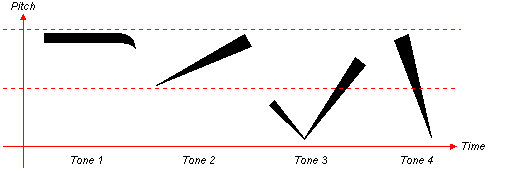
In Chinese it is always very important to pronounce words with correct tone. In transliterated Chinese, tone markings are written over the central vowels in most syllables. Some syllables have no specific tone, and then no sign is put above any vowel. In Mandarin Chinese there are four tones:
- The 1:st tone is marked with a line (”a” + “-” = “ā”). This is a high, even and constant tone.
- The 2:nd tone is marked with a rising line (”a” + “? = “á”). This is a rising tone that grows stronger.
- The 3:rd tone is marked with a hook (”a” + “v” = “ă”). This tone is first falling and fading, then rising and growing strong.
- The 4:th tone is marked with a falling line (”a” + “`” = “à”). This is a quickly falling and fading tone.
In unstressed syllables the tone may be hardly noticeable. In such cases, no marking is put above any vowel. You may regard this as “tone zero”. The tone will usually end up more or less where the previous syllable ended.