
Chinese allegorical sayings:Confucius moves house 孔夫子搬家
Tue 18 Sep 2007Posted by Mr.WHAT under Chinese Proverbs
 Chinese culture is one of the oldest cultures in the world. Chinese proverbs have said to have been around for thousands of years. These proverbs can be placed into four different categories, 歇后语 xiehouyu (two-part allegorical sayings), 谚语 yanyu (familiar sayings), 成语 chengyu (accepted phrases), and 俗语 suyu (popular sayings).
To liven up your spoken Chinese, ChineseHour Blog will present you a selection of everyday idioms, which are interpreted in English with fantastic images, and demonstrated with examples. The Chinese allegorical sayings 歇后语 (xie hou yu) have been chosen for their frequency of use, practical value and expressiveness.
Today, we’ll teach you a very common one relating to the great master, Confucius.
孔 夫子 搬家— 净 是 输(书)。
Kǒng fūzǐ bānjiā, jìng shì shū.
Confucius moves house - nothing but books (always lose).
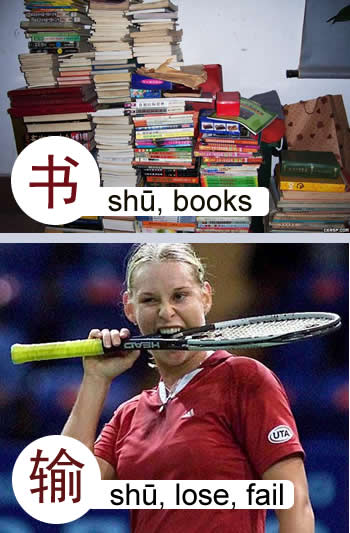
From the image here you can find out that the character 书 (book) and 输 (lose) sound the same “SHU”. This is a very typical pun in Chinese sayings, it means ALWAYS LOSING OUT.
Confucius, the founder of the Confucian school, was considered the most learned scholar in ancient China, so there must have been a great number of books in his home. When he moved house, what he took with him was probably mostly books. 书 (shū, book) , however, sounds the same as 输 (shū, to lose) . People love to use this idiom to describe his/her successive failures for a match, mostly for the gambling games in a humous mood. For example:
A: — 昨天麻将成绩如何?
Zuótiān májiàng chéngjì rúhé?
How about your goals with Mahjong yesterday?
B: — 哎, 手气 太 差!孔 夫子 搬家— 净 是 输。
āi, yùnqì tài chà! Kǒng fūzǐ bānjiā,jìng shì shū.
O, very bad luck! Just as Confucius moves house!
(Note: Mahjong, a four-person playing game, is a most common gambling game for friends at home to kill leisure weekend in China today.)