
The best-known Chinese director: Zhang Yimou 张艺谋
Thu 19 Apr 2007Posted by Mr.WHAT under Chinese Celebrity
[3] comments
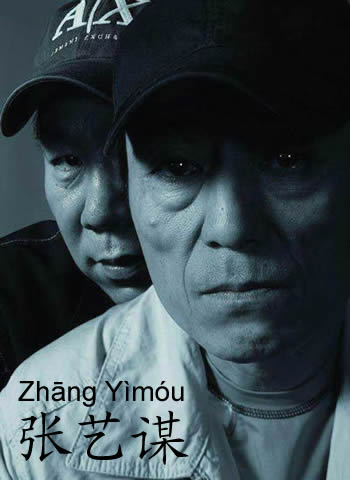 张艺谋 Zhang Yimou
张艺谋 Zhang Yimou is one of the best-known directors of the Chinese Fifth Generation and one of the most influential and widely respected filmmakers working today.
A leading filmmaker of China’s “Fifth Generation” who began as a cinematographer and has shot films by directors Chen Kaige and Wu Tianming, Zhang Yimou made an auspicious directorial debut with “Red Sorghum” (1987), which won the Golden Bear at the 1988 Berlin Festival. Set in the remote Shandong province in the 1930s and rich with mythical overtones, “Red Sorghum” uses minimal dialogue, haunting music and stunning visuals to tell the story of a meek young bride who develops into the forceful head of her husband’s winery after his death.
His second feature, “Ju Dou” (1990) about a young wife, sold to a brutal old man, who has an affair with his son in order to provide her husband with an heir, became embroiled in controversy when it was submitted as Best Foreign Film to the Motion Picture Academy’s nominating committee by the Chinese government and then was officially withdrawn because the film had not been theatrically released in China. The Motion Picture Academy then hastily changed its eligibility rules to allow “Ju Dou” to compete for an Oscar.
Zhang continued his streak of critically acclaimed films with “Raise the Red Lantern” (1991), a strikingly filmed drama about the trouble a man’s latest addition to his bevy of wives causes. He followed up with a lighter but still powerful film, “The Story of Qiu Ju” (1992), about a tenacious farmer determined to right a wrong done to her husband. As with all Zhang’s films, it starred Gong Li, an intelligent, naturalistic actress who aptly embodied the tension between the graceful surface of cultural tradition and the turbulence of youth and injustice towards women which all his films explore. The importance of gender roles in maintaining hierarchies in Chinese society again fueled Zhang’s story of a prostitute’s travails, “Shanghai Triad” (1995), while the family of “To Live” (1994) endures the turbulence of the 1940s through the 70s, a key transition period in contemporary Chinese history.
Zhang continued to deliver accomplished films, including “Keep Cool” (1997), “Not One Less” (1999) and “The Road Home” (1999; U.S. 2001). He struggled, however, with a young Chinese audience that grew to dislike the director’s fixation on the nation’s part. He also found himself compromising his art to appease the government, such as changing the original laid-off workers of “Happy Times” (2001; U.S. 2002), struggling for dignity while submitting themselves to ever more degrading types of work, into retirees, as ordered by the Chinese Film Bureau.
Nevertheless. the director scored one of his greatest cinematic and commercial triumphs, “Ying xiong” (2002), which was released in the United States in 2004 under the title “Hero.” Teaming with Australian cinematographer Chris Doyle and Asian martial arts stars Jet Li, Zhang Ziyi, Tony Leung, Maggie Cheung, Daoming Chen and Donnie Yen, Zhang crafted a big-budgeted, multilingual tale set at the violent dawn of the Qin dynasty, circa 220 B.C., where the soon-to-be first Emperor is on the brink of conquering the war-torn land and three of his most passionate opponents (Cheung, Leung and Ziyi) are trying to assassinate him, opposed by the indomitable Li as Nameless, a lowly policeman who faces off against powerful forces. The film become a phenomenal hit in Asia and Europe (it took the title of the box-office record-holder among Chinese movies), and was nominated for an Oscar in 2003 in the foreign language category before its North American release in 2004.
In 2004 the director also delivered the highly anticipated “House of the Flying Daggers,” a martial-arts love story set in the 9th century Tang Dynasty involving a conflict between government forces and a rebel group featuring Hong Kong heartthrob Andy Lau, Taiwanese Japanese star Takeshi Kaneshiro and Zhang Ziyi. At a point where the Chinese film industry seemed at odds with itself, Zhang hoped to create a film that would be commercially successful both at home and abroad-even as some of his younger colleagues accused him of selling out to pure entertainment over art.
Zhang has often tackled major creative undertakings outside of the film world: In 1999 he mounted an epic production of Puccini’s Turandot in Beijing’s Forbidden City. in 2001 he directed a ballet adapted from “Raise the Red Lantern. The Chinese central government has also conscripted him to craft national propaganda: he directed videos for Beijing’s Olympic bid and Shanghai’s successful application to host the 2010 World Expo.
-
Also Credited As: Cheung Aau Mau
-
Born: on 11/14/1950 in Shaanxi Province, China
-
Job Titles: Director, Director of photography, Songwriter
Significant Others
-
Wife: . according to Interview (March 1991), refuses to give Zhang a divorce
-
Companion: Gong Li. starred in Zhang’s “Red Sorghum”, “Ju Dou”, “Raise the Red Lantern” and “The Story of Qiu Ju”; no longer together
Education
-
Beijing Film Academy, Beijing, China, 1978-88
Milestones
-
1966 Due to the Cultural Revolution, studies suspended and sent to work in the countryside, first on farms in Shanxi province and later as a laborer in a spinning mill
-
1982 Assigned to work in the Guangxi Film Studio
-
1982 Debut as feature cinematographer, “One and Eight”
-
1985 Transferred to the pioneering Xi’an Film Studio
-
1987 Feature film directing debut, “Red Sorghum”
-
1991 Directed the internationally acclaimed “Raise the Red Latern”
-
1994 Won award at Cannes for “To Live”
-
1997 Debut as opera director with production of “Turandot” at the Teatro Comunale in Florence, Italy; reportedly the first Chinese director of an Italian opera production
-
1997 Helmed the comedy “Keep Cool”
-
1999 Earned critical praise for “Not One Less”, a look at contemporary China as seen through the story of a young schoolteacher and an unruly student; screened at Venice; set to be released theatrically in the USA in 2000
-
2001 “The Road Home”, a drama about a woman recalling her courtship with her now deceased husband, screened at Sundance
-
2002 Directed “Hero”,starring Jet Li and Maggie Cheung; received a nomination for Best Foreign Language Film
-
2004 Directed Ziyi Zhang in “House of Flying Daggers”
-
2006 Directed Gong Li in the historical drama, “Curse of the Golden Flower”; also scripted