

Thought to be the oldest types of characters, pictographs were originally pictures of things. During the past 5,000 years or so they have become simplified and stylised.

Ideographs are graphical representations of abstract ideas.

Compound pictographs and ideographs combine one or more pictographs or ideographs to form new characters. Both component parts contribute to the meaning of the compound character.
Note
The character for thought was originally a combination of the characters for brain + heart. In the modern character the brain component has been replaced by the character for field, which is very similar to the one for brain.
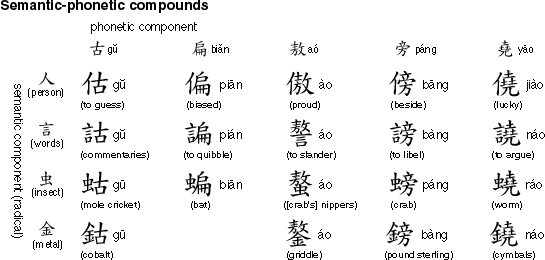
Semantic-phonetic compounds represent around 90% of all existing characters and consist of two parts: a semantic component or radical which hints at the meaning of the character, and a phonetic component which gives a clue to the pronunciation of the character.
Characters containing the same phonetic component may have the same sound and the same tone, the same sound but a different tone, the same initial or final sound, or a different sound and a different tone.
Phonetic components are generally a more reliable indication of pronunciation than semantic components are of meaning.
Numerals
The complex numerals are used on cheques, banknotes and coins and are the equivalent of writing ‘one’, ‘two’, ‘three’, etc, rather than 1, 2, 3. The simple numerals are used for everything else. The same numerals are also used in Japanese and Korean.

Large numbers are divided into units of ten thousand, so 1 million is one hundred ten-thousands.
WordPress database error: [Table './wordpress/wp_comments' is marked as crashed and last (automatic?) repair failed]
SELECT * FROM wp_comments WHERE comment_post_ID = '415' AND comment_approved = '1' ORDER BY comment_date