Learn chinese | Chinesehour

Today we’ll learn a common Chinese everyday expression: 打工 dǎ gōng.

打工 dǎ gōng


It indicates that one works for others, instead of being an employer or a boss.

People say it often when one is asked to make a decision but he/she does not has the right to do it, it is very good excuse to say so and refuse the request; or one modestly indicates that he/she makes little money not much as you have expected.

打dǎ has many meanings, here it means “fight” or “help” (e.g.: 打不平dǎ bù píng, help victims of injustice); 工 gōng — means work or job.

________________________________

For example:

1)

Duì bu qǐ,

,

zhè shì wǒ jué dìng bù liǎo

了,

wǒ zhǐ shì gè dǎ gōng de

的。

Wǒ dé qǐng shì zǒng jīng lǐ cái xíng.

行。

Translation:

Sorry, I don’t have the right to say yes for it.

I am just a common staff here. I’ll have to ask for the manager.

________________________________

2)

Mǎi chē

车?

Nǎ lái qián ya?

Wǒ zhǐ shì gè gōng de


Translation:

Buying a car?

Where can I get so much money?

I am not a boss!

_______________________________

Tips: Visit ChineseHour.com to learn Mandarin Chinese with native speakers 24/7 in Conversation Class LIVE and the Self-Paced Courses!

[Slashdot] [Digg] [Reddit] [del.icio.us] [Facebook] [Technorati] [Google]

Chinese Cuisine, Features, Local Styles, Medicated Diets
中国菜 地方菜系 闻名菜谱 药膳(zhōng guó cài, dì fāng cài xì, wén míng cài pǔ, yào,shàn)

Chinese culinary arts are famous all over the world. Chinese dishes appeal to the senses through color, shape, aroma and taste. Chinese cuisine’s entree normally strives for three to five colors, made up of the main ingredient, with more secondary ingredients of contrasting colors and textures; these are prepared and cooked to enhance their own qualities, with the use of appropriate condiments and garnishing, enabling to chef to present a delicious platter of fragrant delicious art.
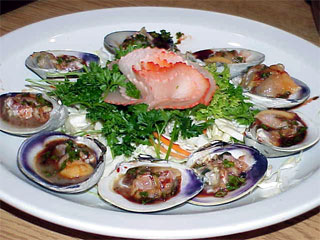
clams In prepared dishes, the stronger fragrant aroma stimulates one’s appetite, by using scallion, fresh ginger, root garlic or chili pepper; with the use of wine, aniseed, cinnamon, peppercorn or sesame oil. Complementary nuances are added. Soy sauce, sugar, vinegar and other seasonings may used discreetly, adding to the complex play on the taste buds.

All chefs of the Chinese kitchens, professional or in the home, strive for harmony of sight, smell, taste, texture, so that each individual dish has it’s unique features highlighted; contrasted and balanced if it is a dinner of many dishes, be it 3, 6, 9 or 12. The flavors must not overpower, yet subtle enough to meet the tastes of those dining. Complex or simple dishes may be prepared quickly or much longer, but the ultimate goal is to share with the guests the play on the eaters’ real and imagined visions of the dishes and its ingredients.

Once the meal is cooked, it is served all at once to the family, who eat with chopsticks and drink soup with a wide spoon. The average dinner includes a starch — rice, noodles, bread, or pancakes — a meat dish, vegetable, and soup, which serves as a beverage. For formal meals and banquets, there are many successive courses which are served in a strict traditional order. A further point is that over festive periods, with the play of word’s phonetics, well meaning felicitous names of dishes have many people trying to guess what they are about to eat, thereby adding fun to eating.

Chinese food enjoys a high reputation in the world also for its sheer abundance. It is due to the diversity of the climate, products and customs that there are widely different food styles and tastes in local regions.

For local styles, Beijing cuisine combines the best features of different regional styles. Shangdong cuisine leads the Northern dishes. Shangdong cooks are good at cooking seafood. Sichuan cooks specialize in chilies and hot peppers and Sichuan dish is famous for aromatic and spicy sauces. Guangdong cooking makes use of many ingredients. They look for fresh, tender, crisp textures. Huai Yang cuisine stresses the natural flavors. Dishes are strong but not greasy, and light but delicate. Tan cuisine is both sweet and salty. There is a saying that “southerners have a sweet tooth, and northerners crave salt”, but Tan dishes manage to satisfy both. Because China’s local dishes have their own typical characteristics, Chinese food can be divided into eight regional cuisines, the distinction of which is now widely accepted.
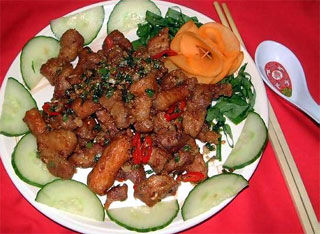
sichuan food Shandong Cuisine

Consisting of Jinan cuisine and Jiaodong cuisine, Shandong cuisine, clean, pure and not greasy, is characterized by its emphasis on aroma, freshness, crispness and tenderness. Shallots and garlic are frequently used as seasonings so Shandong dishes taste pungent. Soups are given much emphasis in Shandong cuisine. Thin soups are clear and fresh while creamy soups are thick and taste strong. Jinan chefs are adept at deep-frying, grilling, pan-frying and stir-frying while Jiaodong chefs are famous for cooking seafood with a fresh and light taste.

Typical menu items: Bird’s Nest Soup; Yellow River Carp in Sweet and Sour sauce

Sichuan Cuisine

Sichuan Cuisine, known more commonly in the West as Szechuan Cuisine, is one of the most famous Chinese cuisines in the world. Characterized by its spicy and pungent flavors, Sichuan cuisine, with a myriad of tastes, emphasizes the use of chili. Pepper and prickly ash are always in accompaniment, producing the typical exciting tastes. Garlic, ginger and fermented soybean are also used in the cooking process. Wild vegetables and meats such as are often chosen as ingredients, while frying, frying without oil, pickling and braising are used as basic cooking techniques.

It can be said that one who doesn’t experience Sichuan food has never reached China. Typical menu items: Hot Pot; Smoked Duck; Kung Pao Chicken; Twice Cooked Pork; Mapo Dofu
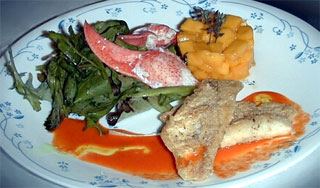
seefood Guangdong Cuisine (Cantonese Cuisine)

Tasting clean, light, crisp and fresh, Guangdong cuisine, familiar to Westerners, usually has fowl and other meats that produce its unique dishes. The basic cooking techniques include roasting, stir-frying, sauteing, deep-frying, braising, stewing and steaming. Steaming and stir-frying are most frequently used to preserve the ingredients’ natural flavors. Guangdong chefs also pay much attention to the artistic presentation of their dishes.

Typical menu items: Shark Fin Soup; Steamed Sea Bass; Roasted Piglet

Fujian Cuisine

Combining Fuzhou Cuisine, Quanzhou Cuisine and Xiamen Cuisine, Fujian Cuisine is renowned for its choice seafood, beautiful color and magical tastes of sweet, sour, salt and savory. The most distinct feature is their “pickled taste”.

Typical menu items: Buddha Jumping Over the Wall; Snow Chicken; Prawn with Dragon’s Body and Phoenix’s tail

Jiangsu Cuisine
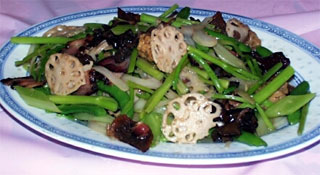
vegetarian food Jiangsu Cuisine, also called Huaiyang Cuisine, is popular in the lower reaches of the Yangtze River. Using fish and crustaceans as the main ingredients, it stresses their freshness. Its carving techniques are delicate, of which the melon carving technique is especially well known. Cooking techniques consist of stewing, braising, roasting, and simmering. The flavor of Huaiyang Cuisine is light, fresh and sweet and its presentation is delicately elegant.

Typical menu items: Stewed Crab with Clear Soup, Long-boiled and Dry-shredded Meat, Duck Triplet, Crystal Meat, Squirrel with Mandarin Fish, and Liangxi Crisp Eel

Zhejiang Cuisine

Comprising local cuisines of Hanzhou, Ningbo, and Shaoxing, Zhejiang Cuisine is not greasy. It wins its reputation for freshness, tenderness, softness, and smoothness of its dishes with their mellow fragrance. Hangzhou Cuisine is the most famous one of the three.

Typical menu items: Sour West Lake Fish, Longjing Shelled Shrimp, Beggar’s Chicken

Hunan Cuisine

Hunan cuisine consists of local cuisines of Xiangjiang Region, Dongting Lake and Xiangxi coteau areas. It is characterized by thick and pungent flavors. Chili, pepper and shallot are usually necessities in this variation.

Typical menu items: Dongan Chicken; Peppery and Hot Chicken

Anhui Cuisine

Anhui Cuisine chefs focus much more attention on the temperature in cooking and are good at braising and stewing. Often ham will be added to improve taste and candied sugar added to gain freshness.

Typical menu items: Stewed Snapper; Huangshan Braised Pigeon
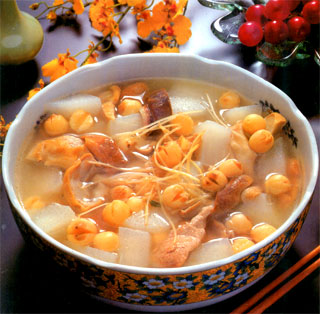
medicated diet Chinese medicinal cuisine is unique in China and has a long history. Sun Simiao, a leading Tang Dynasty doctor, once said, “Food has the function of eliminating evil influences and soothing the vital organs, cultivating one’s mind and building up one’s strength.” In China, people contend that food tonic is much better than medicine tonic in fortifying one’s health. Based on traditional Chinese herbal medicine practice, it combines strictly processed traditional Chinese medicine with traditional culinary materials to produce delicious food with health restoring qualities. To cook medicinal food, one has a large variety of fine materials to choose from and each material has its own unique flavor. Generally, processed herbal materials are more commonly used in order to avoid strong odors. However, individuals of different physical status need to select different herbs. The selection of herbs will depend on each individual’s condition of health. Due to its herbal nature, it is better to take medicinal food according to the doctor’s prescription.

In the cooking of medicinal food, slow cooking methods such as stewing, braising and simmering are usually used in order to extract more of the herbs’ healing properties.

Typical medicine cuisine:

Baby Pigeon Stewed with Gouqi (Medlar) and Huangqi (Membranous Milk Vetch);
Pork Simmered with Lotus Seed and lily;
Pig’s Kidney Stewed with Eucommia Bark.

[Slashdot] [Digg] [Reddit] [del.icio.us] [Facebook] [Technorati] [Google]

Chinese Medical Care
The Chinese medical system comprises mostly of public and private hospitals. Small and personalized clinics are still uncommon.

Most hospitals in China practize the Western medical treatment system while a good percentage practizes Traditional Chinese medicine (TCM). Increasingly, a large percentage of hospitals also practize a mixture of Western and Chinese medicine.

Seeing a doctor in China
In large Chinese cities such as Shanghai or Beijing, there are increasingly a large number of private clinics that are owned and managed by Western doctors or Chinese doctors who have graduated from a country such as USA or UK. Their treatment and management of patients are along those as practized in these western countries but their fees tend to be high and most of their patients are expatriates working in China and the occasional Western tourist.

Seek out the any English newspaper or magazines available and you’ll usually find an advertisement for a Western clinic. Or ask any China-based expatriate for a recommendation.

Most Chinese will visit a local hospital. If your company doesn’t cover medical expenses or you can’t find a Western clinic because you are in a much smaller town, you can also try visiting a local Chinese hospital.

Chinese medical care system is improving all the time but if you need to visit a doctor in a local hospital, especially in a small city, do be prepared for some cultural shock.

Most hospitals do not speak English. You will need to bring a friend along who does. Local hospitals are still pretty poor in the area of personal privacy and so do not be surprised if you share a consulting room with more than one patient.

Treatment are mostly Western medical techniques including diagnosis, medication, injection or the neccessary scans. However, medications can be a mixture of Western and Chinese drugs.

If you need to be hospitalized, you may be shocked by the low hygiene standard practized in the smaller hospitals and privacy is always a problem as you are likely to share a ward with a few other patients. Visiting hours tend not to be observed and some patients has many visitors that may turned a shared ward into a noisy room. You may find such lapse of privacy a major irritant.

Leading medical research in China
China has a long history of medicine and medical research. Today, it is beginning to stake it’s claim on leading medical research with some highly regarded health research breakthrough including gene therapy treatment for cancer victims.

Dr Lin Dinggang is a famous medical doctor trained in John Hopkins hospital in USA and returned to China to continue serving in the area of gene therapy reseach and treatment for cancer. Dr Lin has achieved much success for the use of Gendicine in treating and fighting cancer with gene treatment. Dr Lin has cured many patients of advanced cancer that many other doctors and hospitals has given up hope on. In fact, Dr Lin is is so famous in successful treatment of advanced and last stage cancer that many foreign patients has made their own way to his hospital in Beijing, China.

Traditional Chinese Medicine (TCM)
If you are interested, you may want to visit a hospital or a clinic that specializes in Traditional Chinese Medicine. This include Chinese diagnosis and treatment and may include accupuncture, massage, herbal medicines, heat treatment etc.

TCM has gained international recognition as a viable alternative health treatment method and is even recognized by World Health Organization for it’s effectiveness in the treatment of certain forms of illnesses and diseases.

TCM believes in the ying and yang of the body and it is usually described as ri (heaty) or liang (cooling). When the heaty and cooling elements of the body is not in balance, we fall sick. Chinese herbal medicine is henced prescribed accordingly to the body condition.

If you have a minor ailment such as a cough or flu, Chinese medicine (TCM) is surprisingly effective. Simply enter a medical hall in the streets (looks like a common pharmacy) and they are likely to have a TCM doctor in attendance. Tell them your problem and they are likely to prescribe some herbs for you to boil and drink. Alternatively, they may also have tablet forms of herbal medicine. Take according to prescription and you may be surprised how fast you can recover.

However, if you have a major injury or illness, it is always better to seek Western medical help immediately.

Chinese health belief
Chinese believe in the adage that prevention is always better than cure. Hence, it is very common to see Chinese practize Qi-Gong or Tai-Chi(forms of Chinese martial arts) in parks and gardens to achieve good internal health and strength. You may find further advice in this interesting book.

If you do not have time to pick up such skills, the Chinese always believe that Tui-Na (a form of Chinese massage) and reflexology (Foot massage) can go a long way towards maintaining good health.

The Chinese has a long tradition for Chinese Kung Fu or martial arts. Training injuries are very common and herbal plasters and ointments to treat pain and ache are very popular and effective. If you have pain, arthritis, stiff neck, backache and other pain problem, do visit http://www.quick-pain-relief.com.


The best method to avoid seeing a doctor is not to fall ill. When travelling, get plenty of rest and sleep. Drink plenty of fluid, but in China, try to avoid drinking directly from the water tap. Drink from bottled drinks and always boil the water if your only choice is the tap.

Always eat in a restaurant that has plenty of customers. Avoid restaurants that do not have customers and certainly avoid street stalls.

[Slashdot] [Digg] [Reddit] [del.icio.us] [Facebook] [Technorati] [Google]

Travel and Tour Tips for China
China is a large country at a size of 9,596,960 sq km. China was only partially open to the world from 1980 onwards and has been a communist country for many decades. Although there is much progress in the travel industry and infrastructure of China, there remain areas that need to be improved before it can match the level that most tourist would require.

However, much of the fun remain that it is different from the rest of the world. China will be the host nation for the Olympics in Year 2008. Travel facilities and infrastructure will be improving quickly as we approach Year 2008.

China is rich in culture and history. Visit the Great Wall of China in Beijing, sip Chinese tea in Xiamen, dance with ethnic tribes in Yunnan, check out 19th Century European buildings in Qingdao - there are just so much to do and see in China! Go travel China now!

Below are some travel tips to make your travel in China easier:

Apply for Chinese Visa
China require entry visa from most countries. Apply at the Chinese consulate or through your travel agent before travelling to China. Visit our Apply for Chinese Visa section for more information.

Climate in China
Weather can be extremely diverse; tropical in south of China to subarctic in north of China. Check early and be prepared with the right seasonal clothing.

Foreign Exchange in China
The unit of currency in China is known as Renmembi(RMB) or Yuan. Get some Chinese Yuan in your local country before travelling. When in China, exchange foreign currency for local currency in the banks or at the hotel. Banks tend to give slightly better rates than hotels. Take note that some banks close for a noon siesta between 12-2pm.

Payment facilities
Most better class hotels and shopping centres in China take Credit Card or Travellers cheques. Smaller hotels and shops take cash only. Once out of the bigger cities, credit card and ATM cards tend to be almost impossible to utilize. Cash is still king in Chinese business and trade.

Counterfeit notes are common in China. Check carefully before accepting change, especially if it consists mostly 100RMB notes. You can feel a texture difference where counterfeit notes is concerned.

Use of English in China
Most civil servants, custom officials, police, hotel staff and men in the street do not speak English or at best a smattering of English.

Most signboards and notices will carry both English and Chinese. However, be aware that some translations can be so notorious that one can hardly understand what was it’s original Chinese intention.

Do not expect hotels or shops to understand English. Only the very big hotels will have staff that will understand English.

Most young people can understand basic English if you speak slowly.

Social Security in China
China is generally a safe country. However, hang on tight to your wallet especially in crowded, popular tourist sites in tourist cities such as Beijing and Xian.

These tourist cities also has a lot of touts in the streets touting tourist from currency exchange to jewelleries to female companionships. Avoid at all cost! See our China Public Security page for more details.

Domestic Travel within China
Bus, train, ferries and domestic flights in China are quite well developed. Avoid the crowd at thetrain or bus stations and book your tickets through the hotel tour desk or the nearest tour agent. Prices are likely to be competitive and tickets will be delivered to your hotel room. Again, avoid ticket touts who approach you in the streets.

Local buses are cheap (US$0.10 or YS$0.20) and you may want to try out. Taxis are convenient and are available at all hours. Starting fares differ from each city and may be as cheap as US$0.70 in Weihai and US$1.50 in Shenzhen.

Avoid travel in China during peak holiday seasons or book tickets well ahead.

Local Hotels in China
There is a good choice of hotels in China ranging from one star to the most luxurious 6 stars. Most of the time, the rooms are safe and clean and in my opinion, cheap does not mean bad.

There are many websites selling China hotel rooms on the internet. You can also check out the travel counters which are available in most train, bus stations as well as airport.

Book ahead if travelling in peak seasons.

Peak Tourist Seasons in China
Chinese New Year: Date varies but generally late January or early February.
May Day: First two weeks of May
China National Day: Middle two weeks of October

Avoid travelling during these period. Book rooms and travel modes way early if need to travel. Believe me, the crowds during these period of time will be scary. What do you expect when the entire Chinese nation of 8 billion people are on holiday as well!

Chinese Food
Local food is absolutely fabulous. Try as much Chinese food as your wallet or stomach can afford. Restaurants are available everywhere and open to late hours. Most restaurants will have a menu that include photographs of the various dishes. Better yet, simply point at the food that your next door table is having, especially if it looks delicious!

However, avoid street side stalls and drinking directly from the taps if you have delicate stomach.

Telecommunications in China
Mobile phone coverage in China is good in most locations. Global auto-roaming within China is not a problem.

Internet in China
There are cyber-cafes everywhere in China, especially in tourist areas. Most are patronised by young people playing online games but you still can check your Hotmail, Yahoo or Gmail. Access may be a bit slow for international websites.

You will need to show your passport as China has tight regulations at Internet Cyber Cafes.

Toilet facilities in China
One of the worst experience many has with China is the atrocious toilet facilities. Things has improved very much but it may still be a good idea to empty your stomach or bladder at every opportunity in a hotel, restaurant or departmental store. Public toilets and toilets in small shops can be a nose hazard!

* Useful China travel tips *
Try to get a English speaking tour guide at every opportunity you can. China has a rich and wonderful history and culture and without a guide, somehow, the flavour and significance of most tour sites can be lost.

*Sneaky tip: Hang around a group that has a English speaking guide if you cannot afford one!

Always ask for a receipt from a taxi driver so that you can complain if you have been cheated or for tracing purposes if you happen to leave your camera behind in the taxi.

Try to take the namecard for each hotel that you are staying at as these cards will have a Chinese address and the map of your hotel location. This is useful if you need to seek assistance to find your way back as the English version or pronounciation of a hotel or a street name may be quite different from the Chinese version.

After a tiring day, check out Chinese foot reflexology or Chinese TuiNa (Chinese massage). Wonderful for the body after a hard day and very cheap to boot. Simply look out for shop signs that shows two feet! They are everywhere.

Make friends with the Chinese whenever you can. They love to meet foreigners and will make good tour guides. Just buy a small present as a small token of appreciation.

[Slashdot] [Digg] [Reddit] [del.icio.us] [Facebook] [Technorati] [Google]

Chinese is a language, or a group of languages, spoken by 1.3 billion people worldwide. If you believe Chinese to be one language, rather than a grouping, it is the single most commonly spoken language on the planet. It is spoken in countries like China, Taiwan Singapore, and Malaysia. If you are interested in learning Chinese, it can be intimidating and challenging. But learning Chinese can also be rewarding, and knowing it can have benefits for your career, and help to improve your travels to Asia.

If you decide to learn the Chinese language, there a number of ways you can go about doing so. As a college student, you can study Mandarin Chinese and earn a degree in it. Earning a college degree in Chinese will provide you with a solid knowledge of formal, or Mandarin, Chinese. You will also be proficient in reading and writing the alphabet, which is a standard alphabet throughout the Chinese-speaking world. If you are established in your career, and find it necessary to learn Chinese for business dealings and /or business-associated travel, you can enroll in an accelerated Chinese language course online, or by purchasing audiotapes that teach quick techniques, which will help you to rapidly learn how to speak basic Mandarin Chinese. Learning to speak Chinese this way is convenient if you need to learn it before an important business trip. There are several learning centers that provide accelerated online programs in Chinese, and many lesson on tape available for purchase.

If you are a student majoring of minoring in Chinese, or if you are a tourist with a desire to travel to Asia, an ideal way to learn the Chinese language is through participation in an immersion program. By doing this, you will not only learn how to speak Chinese, but you will learn about and experience Chinese culture. By studying Chinese in a city like Beijing, where the language is natively spoken, you will become part of the life and culture, and you will find learning to speak the Chinese language is much easier than you thought. Since it is a total immersion into the Chinese world, you will learn all conversational and idiomatic styles of the language. You will interact everyday with people who are native speakers of Chinese, and who can’t or won’t speak English with you. You will be taken on guided tours of the famous landmarks, as well as the everyday places. You will grow to understand and recognize the value of the ancient Chinese culture: the history, the art, the architecture, the food, and the people. You will attend courses in which you will learn the complex Chinese alphabet, how to read it, and how to write it as well. Learning the Chinese language by attending an immersion program is an ideal way to go.

If you are fluent in the Chinese language, not only could it help you if are established in a career, but it could also open doors to new careers for you. For example, you could take a job as a foreign language translator, where you would be responsible for translating websites, training documents, and other important business documents, while helping to bridge the communication gap between two very different cultures. You might also consider a career as a teacher if English as a second language. You have the opportunity to relocate to a Chinese-speaking nation, and teach the English language to Chinese students. Being fluent in Chinese will definitely make your relocation less stressful.

Learning how to speak, read, and write the Chinese language has many advantages. It gives you the potential to enhance you career by working and/or traveling abroad, or you would have opportunities to embark on new careers as a translator or a teacher. If you plan to travel to Asia, learning Chinese will make your journeys less stressful and more enjoyable. Taking the time to learning the Chinese language will open your eyes to a new and often misunderstood culture, and is an achievement that can be personally and professionally fulfilling.

中文译文:
汉语是一种语言,也可以说是一组语言,被全世界大概13亿人口使用。如果你相信汉语是一种语言,而不是一组,那么它就是这个星球上唯一一种使用最广泛的语言。说汉语的国家有中国,新加坡和马来西亚。如果你对学汉语感兴趣,那么它将是充满压力和挑战的。但是,我们推荐你们学汉语,因为了解它对你的职业有帮助,同时也可以让你到亚洲旅游更加便利。

如果你下定决心学习汉语了,有很多种学习途径供你选择。如果你是一个学院的学生,你可以选修汉语,并获得相关的学位证书。获得汉语方面的学位证书,可以帮助你形成稳固正式的汉语知识和地道的汉语。你也将能很流利的读写汉字,这些汉字符号是在说汉语的国家流行通用的。如果你已经参加了工作,然后你发现学习汉语对于你的业务和出差很有帮助,你可以注册在线汉语学习课程或者购买能够帮你在短时间内学会说汉语的听力磁带。如果你需要在一次重要的出差以前学习汉语,那这个方法是很方便的。现在有很多培训机构提供在线汉语速成教学的项目,并且很多课程被录制成磁带方便购买。

如果你是一个辅修汉语的学生,或者你是一个想到亚洲旅游的游客,那么一个理想的学汉语的途径是通过参加浸泡式汉语学习项目。这样的话,你不仅仅可以学习怎样学习汉语,也可以感受一下中国文化。在像北京这样以普通话作为方言的城市学汉语,你会融入到这里的生活和文化,然后你会发现学说汉语比你曾经想象的要简单。一旦你完全融入到汉语的世界里,你会学到各方面的谈话以及常用语。你每天将会和本土的中国人交流,而这些人可能不会和你说英语。你除了去一些日常需要去的地方以外,你还会被领去参观一些历史古迹。你将会逐渐增加对中国古代文化的了解和认知,包括历史,艺术,建筑,饮食和人物。你将会参加中文学习课程,学习复杂的汉语字母表,它们的读法以及写法。浸泡式汉语学习方法是一个理想的学习汉语的途径。

如果你能说一口流利的汉语,不仅仅可以对你现有的职业起到帮助,还可以为你敞开其他职业的大门。例如,你可以找一份翻译的工作,负责翻译网站,培训文件和其他重要的商业文件。这样可以架起两种完全不同文化之间的沟通桥梁。你也可以考虑做一个英语老师。你将有机会重返说汉语的国家,然后教中国学生如何说英语。流利的中文毫无疑问的让你的重返之旅很轻松。

学习如何说,读,写中文有很多好处。它使你的职业具备了出国工作和旅游的潜力,同时也让你有了转行做翻译或者老师的可能。如果你想去亚洲旅游,学习中文将使你的旅途更轻松更有趣。花一点时间学习汉语,你将会被带入一个新的未知的文化氛围中,也是实现个人满足和工作需要的一大功臣。

[Slashdot] [Digg] [Reddit] [del.icio.us] [Facebook] [Technorati] [Google]
Page 67 of 68« First...«6162636465666768»