Learn chinese | Chinesehour

Chinese Character “HE” for the Philosophy of Harmony 和谐

The Beijing Olympics opening ceremony began at 8:08 a.m., on the eighth day of the eighth month of 2008. The exact time was picked by organizers because of the meaning of the number eight to the Chinese. It represents luck, prosperity and wealth. It was an appropriate number, apparently, as the opening ceremony and the Olympics in general have painted a picture of the new China: increasingly prosperous, powerful, harmonious and open.  

A major theme of the Olympics has been “harmony.” During the MovableType show of the performance, the Chinese character of “He” or 和 was shown three time. 和 is written in Pinyin Chinese as He, but it is pronounced more similar with the English word: Her.

Indeed, this has been the overriding theme of the Chinese Communist Party for a number of years. China aims at building a “(和谐社会hexie shehui) harmonious society ,” which means a number of things: shrinking the wealth gap between the rich and the poor, improving relations between humanity and the environment, and a peaceful world order-something especially important, given that experts say China is likely to be the world’s dominant power within a few decades.

The interpretation of the characters “和谐 (hexie)”: “he 和” consists of two parts: ‘mouth’ and‘millet’. The ‘mouth’ and the ‘millet’ components of the ‘he’ character demonstrate that everyone has food to eat; the ‘xie 谐’ character indicate that everyone has words to speak. Interpreting ‘hexie’ (harmony) in this way is not only coincidence, but is the pleading of a China in transition, a pleading to “properly solve the problems of the people’s livelihood and democracy” in order to bring about basic ‘hexie’ (harmony).

Here are common expressions and proverbs with Chinese character “he 和” prepared by ChineseHour teachers. If you have any problems in using these popular Chinese expressions, please turn to Chinese teachers at www.chinesehour.com for immediate help any time of the day.

和谐 héxié, harmony / harmonious

和平 hépíng, peace

和谈 hétán,peace talks

和好 héhǎo, become reconciled

和平鸽 hépíng gē, peace dove

和气生财 héqì shēngcái
Harmonious relationship leads to good fortune.

和为贵 hé wéi guì
Harmony is most precious. Peace is to be cherished. (Confucius)

君子和而不同 jūnzǐ hé ér bùtóng
Gentlemen seek harmony but not uniformity. (Confucius)

天时地利人和 tiānshí dìlì rénhé
Good opportunity, favorable geographical location and support from the people.

-
ChineseHour is your first place to learn Chinese online from native Chinese teachers . Click here to have a quick look at the 1-on-1 instant tutoring courses available at our site.

[Slashdot] [Digg] [Reddit] [del.icio.us] [Facebook] [Technorati] [Google]

Chinese Elements in the Opening Ceremony of Beijing Olympic Games

北京奥运会开幕式的中国元素

-

After the Opening Ceremony of XXIX Olympic Games in Beijing is over for 48 hours, I am thinking about the little difference people in China and foreign audience may react to the same event. I believe there must be some difference because of the different cultural background, and difference in other experiences. For example, the Chinese may react a little bit more modest to the event than the western viewers because people get used to the scene of many actors lining up as a matrix and doing exactly the same thing, while many people in the west didn’t often seen such arrangement, especially in this large scale.

Besides that, there are many points that made the ceremony received better for Chinese than for foreigners. It is all about the cultural meaning of many arrangement. Let me try to explain some of them to my foreign readers. However, no matter how hard I try, my explanation is far from professional level.

The Opening - the Drums

The very impressive 2008 people hitting drums, and did the count down was reported as “Drum Show” in many media. Actually, what they were hitting was not drum. It is called Fou (缶). It is the ancient Chinese container for wine. In the Qin Dynasty (200 BC), people start to hit the Fou to express welcome to friends, especially for friends from far away.

While they hit the drums (let me still call it drum for the time being), they are reciting the famous quote from Confusion: “有朋自远方来,不亦乐乎?”, or using direct translation: “Friends coming from far away, isn’t it happy enough?”, or a better translation: “Welcome friends from the world”.
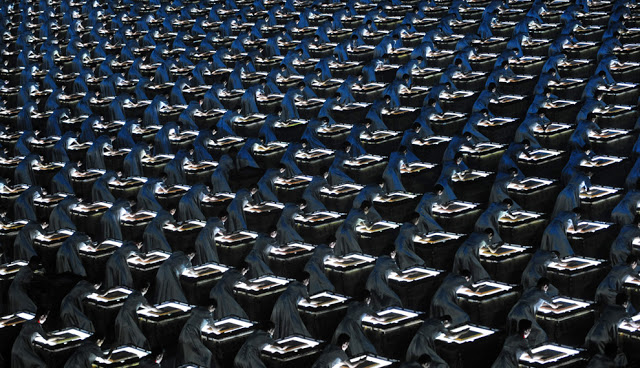

Image Credit: Getty
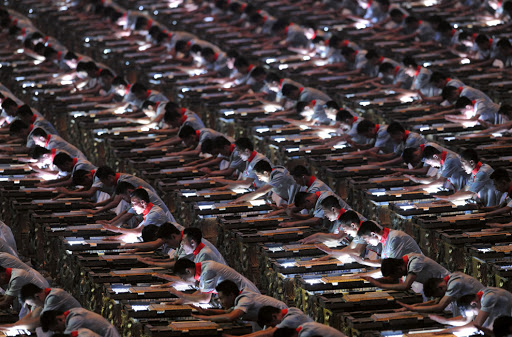

Image Credit: Getty

Don’t worry. No matter you see the meaning behind it or just see it as many people playing drum, it is the same thing - you get the idea of welcome anyway.

The Count Down

It is funny to see the final 10 count down was displayed in both Chinese and number:
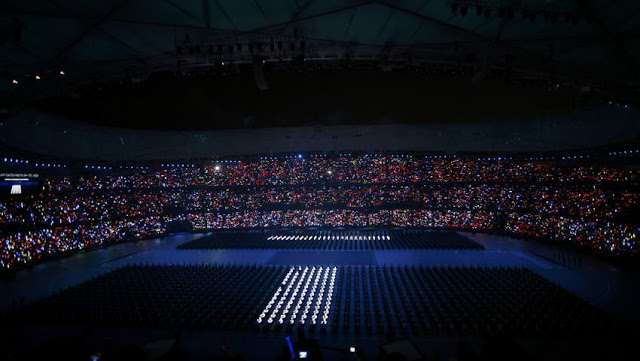

Image Credit: REUTERS/David Gray

As shown on the picture above, at the lower side, it is number “1″, and on the top, it is Chinese for number 1: “一”, in the shape of —

Here is the table of Chinese characters and numbers:
一 1
二 2
三 3
四 4
五 5
六 6
七 7
八 8
九 9

The interesting entry level characters are one, two, three. Chinese is simple enough to have one stroke as one, two horizontal stroke as two, and three strokes as three. (See more explanation in my article “Chinese Characters“). Stop here, since four is not four horizontal strokes.

The MovableType

I believe most people may have recognized what this is:
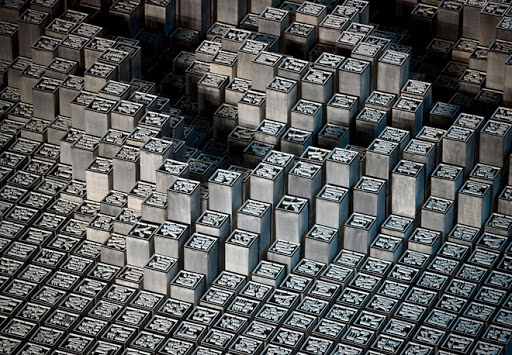

Image credit: Getty

As shown on the picture above, on top of each pole are a reversed Chinese character. If you haven’t seen Movable Type by yourself, you can imagine it is a huge Chinese typewriter. English only have 26 letters with upper case, and lower case, and some symbols. An English typewriter may have less than 100 different types. A Chinese type writer that we use contains thousands of characters. The Movable Type technology was invented in Song Dynasty in the year of 1040.
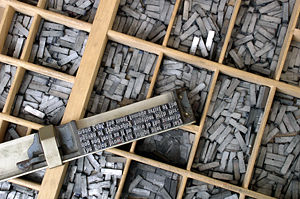

Image credit: Wikipedia

—————-

The Character He 和, or Peace

During the MovableType show (don’t confuse it with the software I am using to write this blog), the Chinese character of “He” or 和 was shown three time.


Image credit: Getty via Yahoo

和 is written in Pinyin Chinese as He, but it is pronounced more similar with the English word: Her.

The character means peace, and harmony. The character does not really look like the one I displayed in this blog entry (if you have the Chinese system to show it. It is because the Chinese characters change its shape over the one thousand year. A good way to think about it is the English letter have different font. Some are pretty similiar with each other, but for some particular letters, the variation is big. For example, the letter E may have completely different way to write it in different handwriting fonts. The difference in Chinese is, there are several thousands characters and each has the tens of varations.

The Order of the Delegation Entrance

One of the most funny part of the ceremony was the entrance order of the delegates. It is maybe one of the few events in the Olympic history, or the recent world events that the order was completely taken with the Chinese way.

I believe many of my friends (I especially have my extended family member, Carrol and Jim in my mind when I write this article) may wonder: “What is the confusing order?” I can understand when people see each country’s delegation enter the stadium, the order seemed to be random if you don’t know Chinese. Let me try to explain this way.

Althogh the Chinese character seems very complicated, it also has the forming elements. Just like 26 letters are the basis of all English words, there are strokes that makes up a Chinese character.

Chinese has many different type of strokes, but most of them can be classified as the following five types:

Horizontal Stroke, like 一
Vertical Stroke like 丨
Leaning Stroke like 丿
Dot stroke like 丶
Turning Storke like 乛

(This is completely my own translation, and I believe the Chinese textbook for foreigners may have better commonly accpeted translation).

Take the Chinese numbers I mentioned in my previous article, one requires one horizontal stroke, and two are made up of two…

My last name 王 is made up of three horizontal strokes (like a three 三), but with a horizontal stroke in the middle. So, there are four strokes to this Chinese character.

This page provided wonderful way for you to understand how each character is writen.

Something to note is, how the character is writen has strict rules. Although the final result is the same, how you write the character does matter. Taking the example of 王 (Wang), you may want to write the first horizontal stroke and add the vertical one. Wrong! The right way is write the first two horizontal strokes, and write the vertical one, and finish the character with the last horizontal stroke. Complicated? How Chinese remember it and the billions of people write the character the same way? It is all by memorizing it one by one from very young children.

Here is how the character Wang was written: Stroke order of Wang. (Click the left bottom blue button, and then the right top blue button for the animation to start).

Well. Enough about Chinese characters. This time, the entrance order was determined by the strokes for the Chinese characters for the country/region name.

Australia, for example, is typically No. 3 to enter the venue, but this time, because the first character of the Chinese name: 澳大利亚 took 15 strokes to write, so it is the 203rd country to appear.

Romantic Chinese

There are many elements in the event that shows the romatic side of typically regarded as “serious” Chinese characteristics. Here are some: scenes:

  • The initial video of how paper is made (if you visit towns like Lijiang, Yunan Province and many other places, you have the chance to create your own paper from plant roots. I did it before)

  • The Chinese paintings

  • The dream of flying out to the space, and the beautiful fairy lady flying in the sky

  • Li Ning flied high in the sky with a moon like spotlight following him

All the flying elements are not created just for this event. It is seen in many places throughout the history of China. It also reminds me (a native Chinese) about how romatic our ancesters are. It is just the tough time in the recent centuaries that turned the nation into really over down-to-earth, and reality-driven mentality.


Anything Else?

There are just too many Chinese elements in this show that is hard for me to list. Anyone wants to add more and share your thoughts with our kind readers from outside China? I hope this is a great chance for people outside China to learn this nation a little bit more than 100% human rights, Tibet, freedom of speech, censorship topics. These topics will continue and need to continue, but just as Olympic gives the world a break, let’s give China a break.

-This article is written by Jian Shuo Wang (http://home.wangjianshuo.com/ )

[Slashdot] [Digg] [Reddit] [del.icio.us] [Facebook] [Technorati] [Google]


-
Beijing, Aug 8 - The opening ceremony of the Beijing Olympic Games began in the National Stadium, also known as the Bird’s Nest, in north Beijing at 8 p.m. Friday.

Chinese President Hu Jintao and International Olympic Committee President Jacques Rogge rose from their seats in the VIP stand to wave to a cheering crowd in the full-packed stadium.

To the melodious rhythm of the song ‘A hymn to the motherland,’ the Chinese national flag was ushered in the stadium, and hoisted with the excited and proud home crowd singing the national anthem loudly. Chinese teachers online at http://www.chinesehour.com/ would like to teach you the Chinese lyrics “Gechang Zuguo” 歌唱祖国 (A Hymn to the Motherland) right now, and you can watch the live video of the performance at the opening ceremony:

—Gēchàng zǔguó 歌唱祖国 A Hymn to the Motherland—
-

Wǔxīng hóngqí yíngfēng piāoyáng
五星红旗迎风飘扬,
Five-Starred Red Flag is fluttering in the wind,

Shènglì gēshēng duōme xiǎngliàng
胜利歌声多么响亮;
With the majestic hymn of victory;

Gēchàng wǒmen qīnài de zǔguó
歌唱我们亲爱的祖国,
We sing in praise of our beloved motherland,

Cóngjīn zǒuxiàng fánróng fùqiáng.
从今走向繁荣富强。
Toward a prosperous and strong nation.

Gēchàng wǒmen qīnài de zǔguó
歌唱我们亲爱的祖国,
We sing in praise of our beloved motherland,

Cóngjīn zǒuxiàng fánróng fùqiáng.
从今走向繁荣富强。
Toward a prosperous and strong nation.

-

Yuèguò gāoshān, yuèguò píngyuán.
越过高山,越过平原,
Across the mountains and the plains,

Kuàguò bēnténg de huánghé chángjiāng,
跨过奔腾的黄河长江;
Over the turbulent Yellow River and Yangtze,

Kuānguǎng měilì de tǔdì,
宽广美丽的土地,
The beautiful and vast land,

Shì wǒmen qīnài de jiāxiāng,
是我们亲爱的家乡,
Stands our beloved motherland.

Wǒmen ài hépíng, wǒmen ài jiāxiāng,
我们爱和平,我们爱家乡,
We love peace and our hometown.

Wǒmen tuánjié yǒuài jiānqiáng rú gāng.
我们团结友爱坚强如钢。
The unity and mutual love makes us steel-like strong.

-Repeat-

- Any problems in reading the Chinese lyrics, please turn to Chinese teachers online FREE anytime at www.chinesehour.com for immediate help. You can learn to speak Chinese online from native teachers at the comfort of your home or workplaces.

[Slashdot] [Digg] [Reddit] [del.icio.us] [Facebook] [Technorati] [Google]

北京奥运主题歌MTV《我和你》

Beijing Olympic Theme Song “You and Me”

Chinese singer Liu Huan and British singer Sarah Brightman jointly present the theme song of the Beijing 2008 Olympic Games. Liu Huan, 45, is one of the most popular male pop singers in China, while Sarah Brightman, 48, is a world famous soprano who is also an actress, song writer and dancer. Online Chinese teachers from ChineseHour.com will be happy to teach you Chinese lyrics here right now with the MTV. Here are the easy lyrics in Chinese:

我和你 Wǒ hé nǐ(You and me)

-

Wǒ hé nǐ, xīn lián xīn, tong zhù dìqiúcūn,

我和你,心连心,同住地球村

You and me, From one wold, We are family.

Wéi mèngxiǎng, qiānlǐ xíng, xiānghuì zài Běijīng。

为梦想,千里行,相会在北京。

Travel dream, A thousand miles, Meeting in Beijing.

Láiba!Péngyǒu,shēnchū nǐ de shǒu,

来吧!朋友,伸出你的手,

Come together, Put your hands in mine,

Wǒ hé nǐ, xīn lián xīn,yǒngyuǎn yìjiārén.

我和你,心连心,永远一家人

You and me, from one world, We are family.

_

Any problems in reading the Chinese lyrics for Beijing Olympic Theme Song - You and Me, please turn to Chinese teachers online FREE anytime at http://www.chinesehour.com/ for immediate help. You can learn to speak Chinese online from native teachers at the comfort of your home or workplaces.

[Slashdot] [Digg] [Reddit] [del.icio.us] [Facebook] [Technorati] [Google]

Top 8 Chinese expressions for you

to talk about Beijing Olympic Games

你的8句奥运地道汉语

How will you talk to your Chinese friends about your interests in Beijing Olympic Games? Chinesehour teachers carefully selected top 8 Chinese expressions for you to practice and we list the situations where you can speak them out. Any problems in understanding them, please turn to Chinese teachers online FREE anytime at http://www.chinesehour.com/ for immediate help.

-

1. 你好,你好! Nǐhǎo, nǐhǎo!

Hello. How do you do? (A repetitive use makes you sound like a native.)

2. 加油, 加油!北京加油!Jiāyóu,jiāyóu!Běijīng,jiāyóu!

Cheerio! Cheerio! Cheerio Beijing!(For Cheering squads. A repetitive use makes you sound like a native. Any problem in these expressions, get Chinese teachers online free at http://www.chinesehour.com/.)

3. 我参与, 我快乐! Wŏ cānyŭ, wŏ kuàilè!

I participate and I enjoy!
(To express your love for the participation in the Olympics even as a spectator. This expression is originally a slogan for the Volunteers drive in Beijing Olympic Games.)

4. 为奥运干杯Wéi àoyùn gānbēi!

Let’s have a toast to the Olympic Games!
(It is used when proposing a toast to the sporting feast at a banquet. )

5. 北京奥运圆满成功! Zhù Běijīng àoyùn yuánmǎn chénggōng!

Wish Beijing Olympics an all-round success.

(To express your blessings. Any problem in these expressions, get Chinese teachers online free at http://www.chinesehour.com/.)

6. 我爱北京! Wǒ ài Běijīng.

I love Beijing.

(To express your enthusiasm. Also you can say anything to replace “Beijing” in “I love …”. For example: “Wo ai Yao Ming (a NBA player from China). Wo ai Niao-Chao (Bird’s Nest, China National Stadium). Wo ai kan tiaoshui (watch diving program). etc”. Any problem in these expressions, get Chinese teachers online free at http://www.chinesehour.com/.)

7. 有朋自远方来, 不亦乐乎?
Yǒu péng zì yuǎnfāng lái,bú yì lè hū?

When a friend comes from afar, is that not delightful? (Confucius)

8. 谢谢。谢谢大家 Xièxiè. Xièxiè dàjiā

Thank you. Thank you everyone!
(A repetitive use makes you sound like a native. “xièxiè dàjiā” is used to express your thanks to many people esp. when closing a speech.)

-

Any problems in understanding them, please turn to Chinese teachers online FREE any time at http://www.chinesehour.com/ for immediate help. You can learn to speak Chinese online from native teachers at the comfort of your home or workplaces.

[Slashdot] [Digg] [Reddit] [del.icio.us] [Facebook] [Technorati] [Google]
Page 9 of 70« First...«678910111213»...Last »